


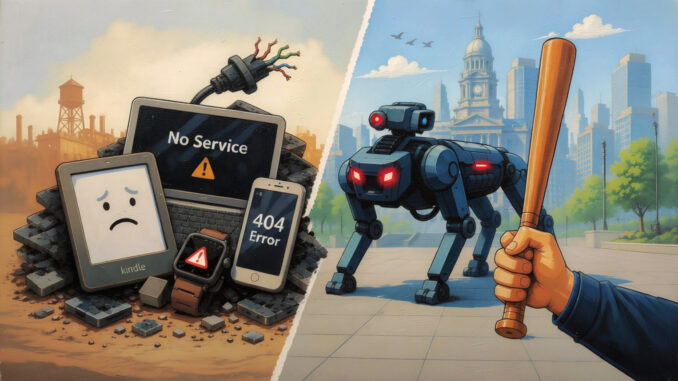

Tech support, but make it weird.
Technology was supposed to make life easier. And sometimes it does! But the future has a funny way of arriving with fine print, dead batteries, and occasionally legs.
Yet modern convenience comes with modern problems. Some are very real, like “planned obsolescence”, where products are intentionally engineered to self-destruct or limit features to force an upgrade. Others perhaps require some imagination – some would say paranoia – but still worth considering in these unprecedented times.
In that spirit, we offer two modest alerts from the tech frontier: one for the gadgets we’d like to keep using, and one for the gadgets we’d prefer not to meet at all.
BRICKED BY DESIGN
May 20th 2026 was an important date for anyone with an old Kindle. That’s the day Amazon pulled the plug on all models from 2012 or earlier, ending support and cutting users off from buying, borrowing, or downloading books from the cloud. Including library books.
Welcome to the world of software-killed devices. Products that still physically work become harder or impossible to use because a company ends support, closes an app, cuts off cloud access, or stops providing updates.
The issue is bigger than Kindles: it’s smart watches, Bluetooth music players, VR headsets, and whole computer systems. When Microsoft cancelled Windows 10 last October, as many as 400 million PCs were knocked out of commission.
Amazon’s recent move sends about 2 million devices to landfills, adding to the 70 million metric tons of e-waste projected to accumulate this year. That’s enough trash to cover the entire city of Philadelphia, thigh-high with electronics. You could fill the Linc stadium 125 times over.
This clutter is only part of the problem – consider the materials, energy, shipping, packaging, and the money from someone paid from their household budget. Mining rare earth materials is also an extremely complex and expensive task, and so is safely disposing them. When working devices get prematurely retired, we all pay the cost in one or another.

The good news is that consumer groups are pushing back, urging Amazon and the wider tech industry to take responsibility for safe disposal of discontinued products, and to allow third-party tools that help people keep those devices alive.
Which seems reasonable enough. If a Kindle from 2012 still wants to be a Kindle, let it be a Kindle. Let readers read. Let libraries lend. Let the little rectangle do its one little job. The most sustainable gadget is not always the newest one. Sometimes it’s the one already sitting on your nightstand.
Get involved! PIRG is a nonpartisan federation of local, independent, citizen-funded Public Interest Research Groups leading the charge. Pennsylvania’s chapter is based in Philly, with a Center City office in the Land Title Building on South Broad Street. @PennPIRG | PIRG.org
😱 Did you know… 89% of smart products can be deactivated at the whim of the manufacturer; there is nothing in the terms and conditions that promises upgrades. – FTC (Nov 2024)
MAN’S WORST FRIEND
With all the drones in the news these days, wise readers will consider personal defense options for autonomous assault.
If a rogue robot dog attack happens, your first move inside your home is critical. Immediately turn off all heat sources, like small fires or stoves, as these machines use thermal imaging to track you down. Your absolute safest hideout is the basement.
Remember, some of these advanced quadrupeds can carry heavy weaponry, and a coordinated swarm can break through standard exterior walls, but you don’t just have to hide, you can actively defend your perimeter. The key is exploiting their physical and sensory weaknesses by setting up low-tech booby traps.
First: build angled slippery barriers at your main entry points using metal sheets or plastic-covered plywood. Slather them in grease, oil, or even loose sand. Their walking mechanisms struggle heavily with zero traction inclines.
Second: scatter loose cords or set up tripwires, their sensors usually can’t process thin wires until they are already tangled in them.
Third: clutter your perimeter with short unstable objects. Robot dogs often fail to register trip hazards less than 30 centimeters high, meaning everyday debris like sticks or trash can actually cause them to topple over.
Finally, use mirrors and highly reflective surfaces around your doors. Bright or mirrored reflections confuse their camera and LiDAR sensors, essentially blinding them. If you can force them onto moving surfaces like a treadmill, their stabilization systems will completely fail.
NOTE: The risk for robot dog offensives remains LOW for Philadelphia and surrounding areas. For updates, email drkarl@nwlocalpaper.com.
What do you think? Watch the videos and click the links for more info. Please leave your questions and comments below or engage with the creators on their youtube pages.
Be the first to comment